
The First Illness
Why the Mind That Foresees the Future Makes the Present Ill

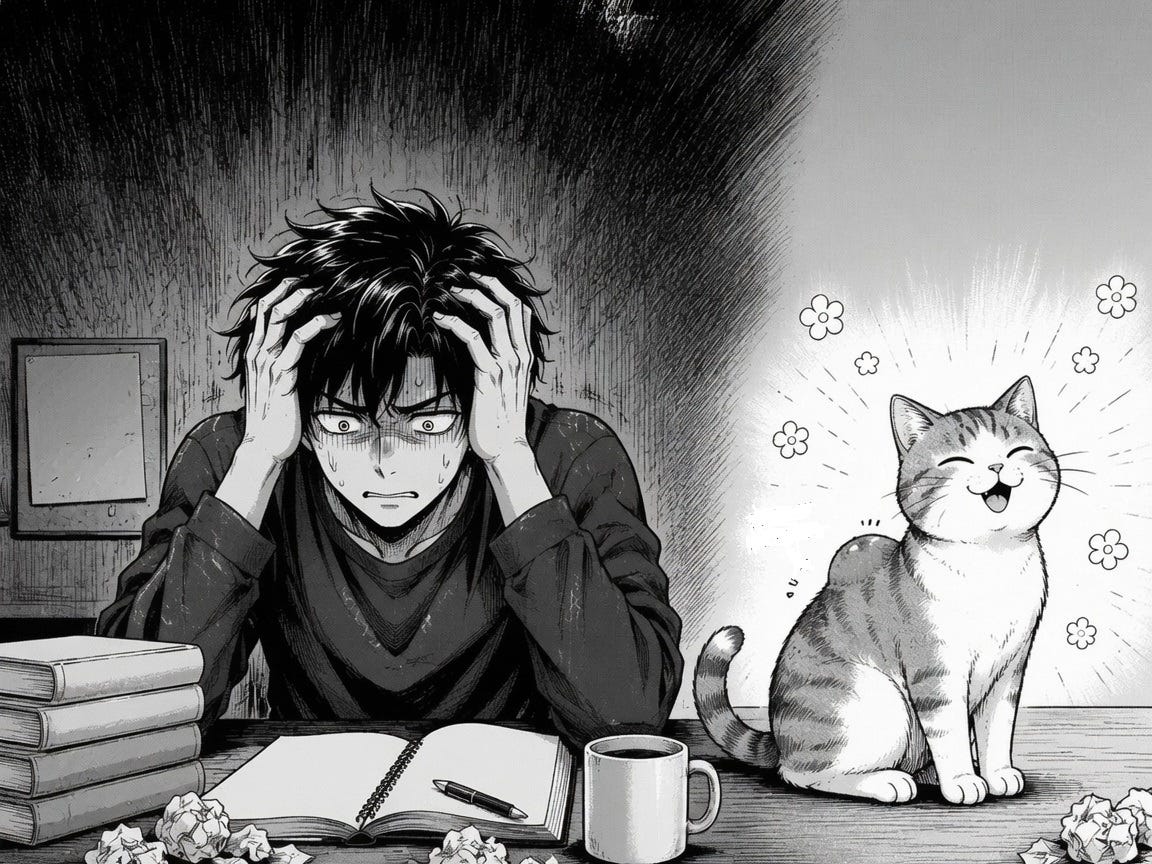
Illness is not simply an abnormality of the body. A lesion becomes an illness when a person predicts a negative future from a bodily change and allows that future to metastasize into the present body, past memories, work, family, and self-image. Humans learned to live longer by anticipating the future. The same ability made it possible for us to become ill before symptoms even appear.
Here, “illness” does not refer only to a medical diagnosis. It refers to the state in which a bodily change begins to carry negative meaning for a person’s future and life as a whole.
1. Is Illness Located in the Body?
What is illness? A bodily abnormality, a loss of function, a condition that causes suffering. That is the usual answer.
Yet bodily states contain no inherent good or evil. Cells proliferate, tissues deform, organs cease to function. At that level, there is only material change. It is human beings—and the medical system that formalizes their judgments—who decide that such changes are undesirable and ought to be treated.
This does not mean that cancer and fractures are merely linguistic inventions. Cancer kills; fractures prevent people from walking. But for either condition to count as “bad,” there must first be a standard of evaluation: the desire to remain alive, to walk, and to avoid suffering. Matter alone contains no declaration of those values.
Illness is not an evil discovered inside the body. It is a bodily change that human beings, through medicine and social practice, have learned to mark as negative.
The important question, then, is where that negative meaning comes from.
Sometimes it comes from pain in the present. But that cannot explain why asymptomatic cancer or hypertension is still considered illness. Much of the burden of illness comes not from present suffering, but from a future that has been predicted.
From this point onward, illness can be understood as the metastasis of anticipated harm into the present.
2. The Future Arrives First
Cancer is discovered during a routine examination. Until yesterday there was no pain, and even today the body feels almost unchanged. Lunch can still be eaten. Stairs can still be climbed.
Yet the moment a physician says, “It is cancer,” the meaning of the body changes.
Perhaps yesterday’s fatigue was already a sign. Perhaps last year’s stiff shoulder was suspicious. Perhaps that slight weight loss marked the beginning of the disease. Harmless events from the past are suddenly rearrested as suspects.
At the same time, futures that have not yet occurred enter the consultation room: surgery, chemotherapy, recurrence, weakness, death. The patient is merely sitting in a chair, yet every future misfortune has arrived together. None of them had an appointment.
What has occurred is not merely the addition of new information. Diagnosis causes the present body to be reread as a body that will deteriorate in the future. That new interpretation is then applied both to past memories and to imagined futures.
Diagnosis does not merely give the present body a name. It pulls the future into the present and then rewrites the past from the standpoint of that future.
The body is almost the same as it was yesterday. What has changed is its position in time.
Illness is the metastasis of future harm into the present.
3. Normality Means Deteriorating on Schedule
Once illness is understood in this way, the boundary between illness and normality begins to look strange.
Much of the value of diagnosis lies in prediction. This tumor will grow. This blood vessel may become blocked. This laboratory value indicates future organ damage. Even when there is no present suffering, a person becomes a patient today if a sufficiently negative future can be predicted.
The reverse is also true. Even substantial discomfort is less likely to be called illness when it occurs as expected. With age, muscle strength declines, memory weakens, the body begins to hurt, and recovery slows. Yet much of this is dismissed with the phrase, “That is your age.”
Not because it is comfortable. Because it is on schedule.
Medical abnormality, then, does not simply mean a bad condition. The same bodily change becomes abnormal if it falls outside the expected age, speed, or distribution, and normal if it remains within them. A change called aging at eighty may be called disease at thirty.
Normality is not health. It is deteriorating on schedule.
This sounds paradoxical, but it becomes less strange once one considers the function of reference ranges. A normal value is not an ideal value. It is a value expected within a particular population. Medicine classifies not only good bodies and bad bodies, but bodies that remain on schedule and bodies that depart from it.
Illness is therefore not only the name of a bodily state. It is also the name of a position on a timeline.
4. Human Illness Metastasizes Beyond the Body
The problem can now be extended from the body to life as a whole.
A cat may have a sarcoma on its back and, at least in the early stages, barely care. It does not hurt. The cat can still move and eat. For the moment, then, the tumor has nothing to do with this afternoon’s nap.
The tumor already exists. But it has not yet metastasized into the cat’s entire life.
Humans are different. The moment a small tumor is found, it no longer remains confined to one region of the body. Can I continue working? How should I tell my family? Will insurance cover the treatment? What will happen to retirement? Am I no longer a healthy person?
The tumor itself may be only a few centimeters wide, but its meaning spreads into work, family, money, the future, and self-image. Even the past is edited into “the period during which the disease was already hidden.”
A cat’s tumor is first located on its back. In a human being, a tumor metastasizes into an entire life the moment it is diagnosed.
Cats, of course, can also feel fear and anticipate danger. The difference is not the presence or absence of suffering. It is the number of domains into which illness can spread. A human being can connect one diagnosis to a mortgage, a child’s education, a professional role, and the evaluation of an entire life.
What is distinctive about human suffering is not necessarily its intensity. It is the area it occupies.
Pain occurs at one point in the body. Illness translated into language metastasizes into time and relationships that remain physically untouched. Humans become ill not only through pain itself, but through the possibility of pain, extending illness into regions where nothing has yet happened.
5. Illness Proliferates Within Temporal Consciousness
Why, then, does the meaning of illness spread so widely in human beings?
Because humans do more than predict the future. They put the predicted future into words, repeat it, and then observe the present self who is afraid of it.
I may become ill. What will happen to my family then? What if I can no longer work? Does my inability to endure this anxiety mean that I am weak? If I am weak, perhaps I will not be able to endure treatment either.
The first prediction changes the self-image, and the altered self-image becomes material for the next prediction. Anxiety about the future changes the present self, and that present self is then used to calculate an even worse future.
Human anxiety does not merely receive information from outside. It uses the self as raw material and proliferates recursively. The output becomes the next input; anxiety begins feeding on itself.
This ability produced planning, science, insurance, and preventive medicine. An animal capable of predicting next year’s famine can store food today. A human capable of predicting a heart attack ten years from now can begin lowering blood pressure in the present.
The same ability generates suffering that does not yet exist.
Animals also anticipate danger. But humans can incorporate not only future pain, but also the self who fears that pain, into a narrative and return it to the present again and again.
Humans become ill from the future in which they may become ill, long before the illness itself arrives.
6. Medicine Reduces Illness and Increases the Number of Patients
Medicine intensifies this temporal metastasis.
In the past, people often became patients only after symptoms appeared. There was pain, bleeding, or an inability to walk. The body announced the abnormality first, and medicine supplied the name afterward.
Now testing discovers illness before symptoms do. Even when a person feels nothing, imaging, genetics, and molecules in the blood can reveal the future. The test result becomes a more authoritative truth about the body than bodily sensation itself.
Eventually, genetic information may be read at birth, and someone may be told, “Around the year 2058, this part of your body is expected to fail.” A fifty-year medical history will be pre-released to a healthy infant.
If the prediction is accurate enough, prevention becomes possible. Life may be prolonged. But a new question then appears: at what age did that person become a patient? On the day symptoms began? On the day a biomarker changed? Or on the day a genetic risk was disclosed?
Illness has not necessarily increased. The date on which one becomes a patient has been moved forward.
Early detection saves lives. That is difficult to dispute. But early detection also extends the period during which one lives as a patient. If an illness is discovered ten years earlier, there is both the possibility that death will be postponed and the certainty that the person will spend ten additional years knowing about it.
By finding bodily lesions earlier, medicine causes their meaning to metastasize across a longer span of time.
The intelligence developed to reduce illness increases the amount of time lived as ill. This is not a failure. It is a side effect of success.
7. The First Illness
The argument so far suggests that a lesion and an illness are not the same thing.
A lesion exists in space.
Illness spreads through time.
A lesion is a change in cells or tissues. Illness is the state in which a negative future is predicted from that change and metastasizes into the present, the past, work, relationships, and self-image.
Medicine primarily measures the former. Human beings live the latter.
Humans increased their chances of survival by learning to foresee the future. We learned to detect illness early, treat it, and extend life. The same ability brings suffering that does not yet exist into the present and makes people ill before symptoms appear.
We predict the future.
We fear that future.
We observe the self who is afraid.
Then we worry about the future of that self.
Illness does not grow only inside the body. It also proliferates within human temporal consciousness.
If so, perhaps the first illness unique to human beings was not cancer, infection, or aging.
Perhaps it was the capacity to recognize illness itself.
Of course, this is not an illness in the medical sense. But it precedes every illness in one decisive respect: it converts a change at one point in the body into a negative meaning that occupies an entire life, and it produces present suffering from pain that does not yet exist.
The intelligence that discovers illness causes illness to metastasize through time.
Cancer metastasizes through the body.
Illness metastasizes through time.
The human being is an animal that lives longer by foreseeing the future—and becomes ill earlier for exactly the same reason.