
There Is No Evolution, Only Adaptation
IP Survival Strategies in Dragon Quest and Final Fantasy

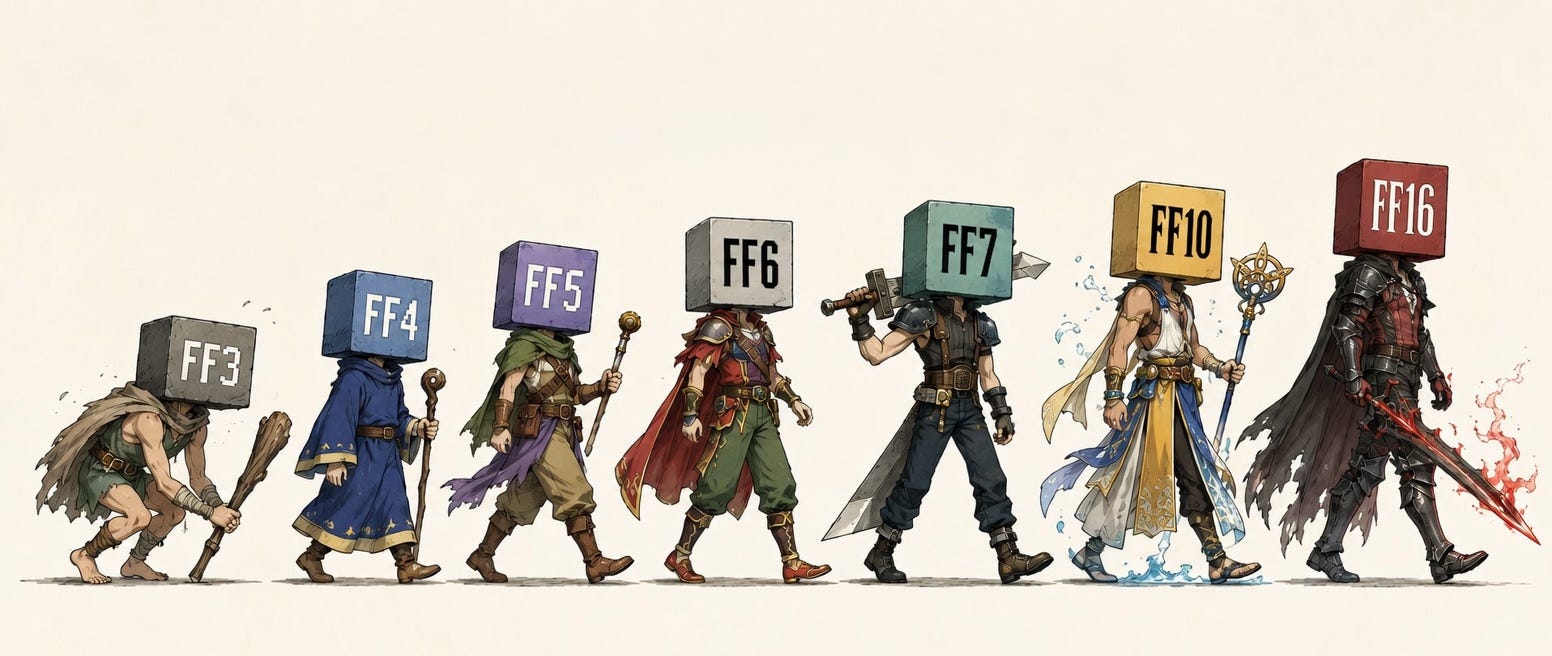
<Key Points>
1. “Evolution” is not progress or upward movement. It is merely adaptation to an environment. The difference between Dragon Quest and Final Fantasy is not one of superiority, but of two fundamentally different adaptive strategies: preservation and mutation.
2. Dragon Quest adapted to the stable, memory-rich environment of the Japanese market through a low mutation rate. Final Fantasy, by contrast, adapted to a shifting environment of technology, creative expression, and overseas markets through a high mutation rate. Fans are not mere customers; they are the environment.
3. Even after their creators die, IPs (Intellectual Properties) endure as memes: styles, symbols, expectations, and evaluation functions. Dragon Quest survives by preserving the memes of the dead, which makes it especially compatible with generative AI. Final Fantasy, on the other hand, survives by mutating those memes and leaving the dead behind.
Dragon Quest and Final Fantasy have long been spoken of as the two great pillars of Japanese RPGs. Yet the difference between them is not merely a matter of gameplay or worldview. More fundamentally, it is a difference in how two long-running IPs have adapted to their respective environments.
Dragon Quest adapted through preservation.
Final Fantasy adapted through mutation.
By adaptation, I do not mean progress. I do not mean becoming more advanced. Just as organisms leave behind traits suited to their environments, products too leave behind forms suited to the market, user expectations, technological standards, and cultural memory.
In everyday language, the word “evolution” is convenient. Games evolve. Technology evolves. AI evolves. But “evolution” is often used not as an explanation, but as a seal of authority. Without explaining what changed or how, one simply says, “It evolved,” and the change takes on the air of progress and legitimacy.
But in reality, nothing is moving upward.
Only forms suited to their environments remain.
This misunderstanding is not limited to games. We tend to read a story of “progress,” rather than adaptation, into life itself.
Behind this lies a familiar human desire to see ourselves as special. In many Christian-inflected worldviews, humans occupy a privileged position: made in the image of God and placed near the center of creation. Evolutionary theory should, in principle, have displaced that anthropocentrism. Yet ironically, a human-centered narrative often survives within popular understandings of evolution itself.
From single-celled organisms to fish, to reptiles, to mammals, to apes, and finally to humans.
This staircase model is almost a biological version of salvation history.
God creates the world and places humans at the end.
Nature produces life, and humans appear at the end.
The theology may seem to have been discarded, but the structure remains.
“Humans made in the image of God” is replaced by “humans as the pinnacle of evolution.”
But in reality, there is no pinnacle.
There is only adaptation to each environment.
Humans are not the goal of evolution. They are one form of large primate that happened to emerge under certain environmental conditions. Intelligence, language, religion, art — none of these are steps on a staircase leading toward some cosmic purpose. They are merely traits that were adaptive in a particular environment, or byproducts that happened to remain.
This perspective can also be applied to products and IPs.
Products do not sell because they are “superior.”
They sell because they have adapted to their environment.
Series do not continue because they are “developing.”
They continue because they keep adapting to the market.
There is, however, an important caveat: adaptation is not an all-purpose explanation. When we look only at what has survived, we tend to think, “It survived, therefore it must have been superior.” But countless IPs were created with equal care, loved with equal intensity, and thrown into the same historical current — only to disappear. What survived was not necessarily inevitable. What survived is merely narrated afterward as if it had been inevitable.
In the biological world, extinction is far more common than survival. And extinction does not occur simply because something was “inferior.” Sometimes the rules themselves change. What was adaptive yesterday can become a disadvantage today. The same applies to products and IPs.
Seen from this perspective, the difference between Dragon Quest and Final Fantasy becomes clear.
Dragon Quest is not so much a series that takes you to a new world as a device that makes you feel, “I have come back to that world again.” Slimes, heroes, demon kings, churches, the overture, the short lines spoken by townspeople — these are not mere conventions. They are traits through which the Dragon Quest IP adapted to its market.
That said, these elements were not necessarily designed from the beginning to serve that function. Accident, constraint, taste, and byproducts can later be repurposed as style. Present usefulness and original cause are not the same thing.
The environment of Dragon Quest was relatively stable. Users expected Dragon Quest to remain Dragon Quest. Therefore, excessive change would not be innovation; it would be adaptive failure. Not changing became part of its product value.
Final Fantasy, by contrast, works in the opposite way.
Final Fantasy is a series that creates a different world each time: classical fantasy, magical industrial revolution, cyberpunk, school drama, religious states, political drama, medieval dark fantasy. What people expect from Final Fantasy is not “returning to the same world again.” It is: “What kind of world will it show us this time?”
The environment of Final Fantasy was unstable. Visual technology, hardware performance, narrative expression, character design, overseas markets — all were changing. In that environment, not changing was more likely to be read not as reassurance, but as stagnation. For Final Fantasy, mutation was dangerous, but it was also a condition of adaptation.
If Dragon Quest changes too much, people say, “This isn’t Dragon Quest.”
If Final Fantasy does not change enough, people say, “Why isn’t Final Fantasy challenging itself?”
In other words, the two series exist in opposite environments.
Fans are not customers.
Fans are the environment.
Fans do not merely consume works. They react: “This is fun,” “This feels wrong,” “This is nostalgic,” “This is outdated,” “This is ambitious,” “I feel betrayed.” The totality of those reactions constrains the traits of the next product. In a massive IP, creation is not an act of God independent of the environment. It is trait adjustment toward the evaluation function known as the market.
This perspective also helps explain why Dragon Quest is stronger in Japan than overseas. In the Japanese market, Dragon Quest’s low mutation rate functioned not as oldness, but as homecoming. The slime, the hero, the demon king, the church, the overture — these served as devices for rebooting shared memory.
Overseas, by contrast, the same traits are more likely to be read as classical, conservative, or lacking in stimulation. Even the same trait changes its fitness when the environment changes.
Dragon Quest is like a large mammal highly adapted to the stable niche known as Japan. Its generational turnover is slow; it preserves its basic skeleton and maintains its identity by suppressing mutation.
Final Fantasy is more like a microbial IP adapted to a fluctuating environment. Its phenotype shifts dramatically from title to title, allowing it to keep pace with its environment by changing its worlds and systems.
Dragon Quest adapts through a low mutation rate.
Final Fantasy adapts through a high mutation rate.
But adaptation is not a permanent guarantee. When the environment changes, yesterday’s adaptation can become tomorrow’s vulnerability. Preservation-type IPs are strong only as long as the environment itself remains preserved. Mutation-type IPs are strong only as long as the environment continues to fluctuate. If the rules change, either can perish.
And within a single person, an environment that seeks homecoming and an environment that seeks mutation can coexist.
The question is not which is superior. When the environment differs, the optimal adaptive strategy also differs. In a stable environment, preserving traits that have already adapted is rational. In a changing environment, continuing to protect the same traits can itself become adaptive failure.
Here, the death of creators takes on another meaning.
Dragon Quest had three gods: Yuji Horii, Akira Toriyama, and Koichi Sugiyama. But Dragon Quest has already become not merely a work, but a style. And what becomes style can exceed the lifespan of individual creators.
Even if Akira Toriyama is gone, Toriyama-like lines remain. Even if Koichi Sugiyama is gone, a Sugiyama-like musical space remains. Even if Yuji Horii someday steps back from the front line, a Horii-like prose style and sense of timing will remain.
In this preservation-type IP, the death of the creator is not merely a rupture. Rather, it becomes a test of how far the style can be extracted.
The more extractable a style becomes, the more it becomes not only a matter of human memory, but also an object of mechanical regeneration. That is why generative AI is highly compatible with preservation-type IPs. “In the style of Akira Toriyama,” “in the style of Koichi Sugiyama,” “in the style of Yuji Horii” — these are relatively easy to extract as features. But generative AI is not God. It is only a candidate-generation device. What canonizes those candidates is the official institution and the fans.
AI is not a prophet.
AI is a machine for copying scripture.
Final Fantasy, on the other hand, has little need to preserve the styles of its founders. Even after Hironobu Sakaguchi left, even after Nobuo Uematsu moved away from the center, even after the series moved away from Yoshitaka Amano-like art, Final Fantasy continued. That is because, from the beginning, Final Fantasy made “change” itself into its series identity.
Dragon Quest survives by preserving the dead.
Final Fantasy survives by leaving the dead behind.
Creators die. Staff members are replaced. But IPs remain. Not because their souls are eternal. The reason is much colder: the IP has been separated from individual bodies and institutionalized as a protocol of preservation or mutation.
In biology, parents die.
But genes remain.
In IP, creators die.
But what remains is not, strictly speaking, a gene. It is a meme.
By meme, I do not mean an internet joke image. I mean a cultural unit of replication: style, symbols, music, visual design, prose rhythm, expectations, and evaluation functions. If genes are replicators that persist through bodies, memes are replicators that persist through memory, media, institutions, fans, official canon, and AI.
But the important point is not merely the difference between genes and memes.
Genes and memes do not “evolve” in the sense of ascending toward something higher.
They only adapt.
Adaptation does not necessarily mean increasing complexity. Complex forms carry costs: development, maintenance, transmission, and fragility. Even when hardware becomes more powerful, an IP does not have to absorb all of that complexity. The slime remained powerful precisely because it did not become complex. Simplicity is not immaturity. It is replication efficiency as a meme.
By contrast, increasing complexity can raise production costs and sometimes reduce freedom itself. Likewise, the fact that humans are more complex than paramecia does not mean that humans are more “evolved.” Becoming more complex is not evolution, and becoming simpler is not degeneration. It is only a different cost structure in relation to the environment.
Genes remain within biological environments.
Memes remain within cultural environments.
Neither moves upward.
Neither approaches completion.
Only replicators suited to a given era, medium, market, community, and evaluation function remain.
Dragon Quest adapted by preserving those memes.
Final Fantasy adapted by mutating those memes.
There is no evolution.
There is only adaptation.
But even adaptation is not an all-purpose explanation. Behind what appears adaptive lie accident, constraint, rule changes, and survivorship bias.
Dragon Quest fit its environment by not changing.
Final Fantasy fit its environment by changing.
Neither is superior.
There is no staircase of progress here.
There are only forms that remained, amid environment and accident, because they happened to remain.